Action Required Now to Turn Around Road Safety Failures in South Australia
On average, over the past five years, nearly two people have been killed and 15 seriously injured every week on South Australian roads. This level of serious road trauma imposes an annual social cost of more than $633 million to the State, placing avoidable resourcing demands on our police, emergency services, and hospitals.
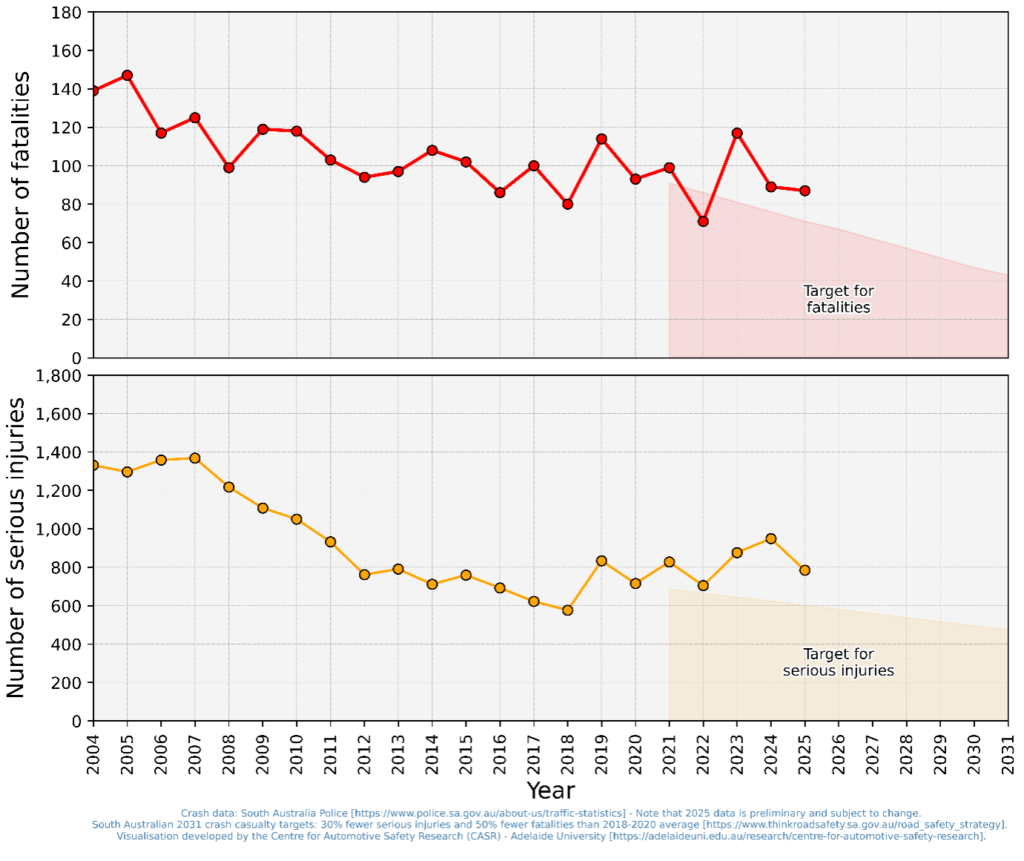
South Australia has now reached the halfway point of its Road Safety Strategy to 2031, and progress is significantly off track. The Strategy commits the State to less than 43 people killed, and 474 people seriously injured per year by 2031 but, in 2025 alone, 87 people lost their lives and 779 were seriously injured on our roads.
This gap between commitment and reality is stark. Road deaths remain stubbornly high and are nowhere near the agreed targets. At the same time, serious injuries continue at alarmingly high levels, leaving hundreds of South Australian families each year to confront potentially lifelong consequences such as brain injuries, spinal damage, and permanent disability.
As shown in the electoral maps this gap in progress is being experienced across all areas of South Australia. The elected members of South Australia’s Parliament are uniquely placed to understand the specific road safety challenges within their own electorates and effectively advocate for improvements. In recognition of this, the Australasian College of Road Safety (ACRS) calls on all candidates standing for election in 2026 to:
- acknowledge the burden of road trauma and social costs in their electorate
- commit to taking action to reduce that trauma and the associated social costs
- accept accountability for the effectiveness of those actions.
While local knowledge is critical, improving road safety also requires strong leadership and coordinated action across government. Meaningful and sustained reductions in road trauma depend on whole-of-government commitment, with road safety embedded across transport, health, policing, infrastructure, planning, and education. The ACRS therefore calls on the next South Australian Government to urgently pursue the following actions:
- Road safety requires independent oversight and guaranteed funding. We call for the establishment of an independent Statutory Office for Road Safety (e.g., a Road Safety Commissioner) to report directly to Parliament on the state’s safety performance.
- South Australian drivers have a right to know the safety rating of the roads they use. In September 2023, all Australian states committed to publishing AusRAP star ratings for their arterial road networks by 2025. South Australia has broken this promise – while the national dashboard was launched in September 2025, SA failed to provide its data. We call on the government to immediately publish safety Star Ratings for the state arterial road network, ensuring accountability and transparency for all road users.
- Current planning rules continue to entrench legacy designs that prioritise private vehicle movement, locking communities into car dependency and avoidable risk. We call on the government to review and modernise design standards to ensure new suburbs are designed with harm-free transport networks, that include essential safety infrastructure for walking, cycling, and public transport delivered from the outset, so residents have safe and genuine travel choices from day one.
- Ambulance ramping cannot be fixed without addressing the preventable trauma that clogs the system. Based on available data, we predict that road crashes result in more than 10 ambulance trips per day in South Australia. We call on the government to treat road trauma prevention as a key lever in its strategy to reduce ambulance demand and hospital overcrowding.
THE TIME TO ACT IS NOW
We cannot accept an average of 94 deaths and 765 serious injuries a year as the ‘price’ of mobility. The next South Australian Government must re-commit to achieving the state’s 2031 road safety targets and the transformation required within South Australia’s road transport system to eliminate fatal and serious injury on our roads.